EN
EN
 fr
fr  de
de  es
es  th
th  ru
ru  tr
tr  pt
pt  ar
ar  ms
ms  id
id 
(With Industrial and Residential Calculation Examples)
In industrial production, commercial operations, and even large - scale residential projects, transformers are the "heart" of the power supply system. They convert high - voltage electricity into usable low - voltage power for equipment, lighting, and other electrical devices. However, choosing a transformer with the wrong capacity (measured in kVA) can lead to a series of problems: an undersized one may cause frequent overload tripping, damage expensive equipment, or even trigger electrical fires; an oversized one will waste energy (due to low load rate and high no - load loss) and increase initial purchase and long - term operation costs.
So, how to accurately select the right transformer capacity? This guide will break down the core steps, key factors, and practical tips to help you make an informed decision, whether you are building a new factory, upgrading a commercial center, or planning a residential community.
Before diving into selection, let’s clarify the basics. Transformer capacity (kVA, kilovolt - ampere) represents the maximum power it can safely deliver to the load, not the actual power consumed. Unlike watts (W), which measure real power used by devices, kVA is "apparent power" — it combines real power (kW) and reactive power (kVAR, used by inductive devices like motors or transformers themselves).
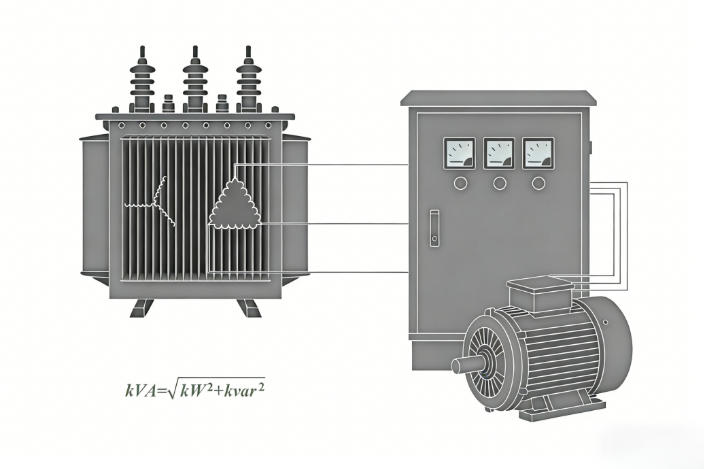
The relationship between kVA, kW, and power factor (PF, a measure of how efficiently power is used) is:
kVA = kW ÷ PF
This formula is the cornerstone of capacity selection. For example, if your total electrical load requires 80 kW of real power, and the average power factor of your equipment is 0.8 (a common value for industrial machinery), the required apparent power is 80 ÷ 0.8 = 100 kVA.
The first and most critical step is to list all electrical devices that will be powered by the transformer and calculate their total real power (kW). This requires attention to two scenarios: continuous load (devices running 24/7, like pumps or servers) and intermittent load (devices used periodically, like welding machines or air conditioners).
How to Calculate:
List every device, its rated power (kW, usually found on the nameplate), and its operating time (e.g., 8 hours/day for a conveyor belt, 2 hours/day for a heater).
For continuous loads: Add their full power to the total (e.g., a 15 kW water pump running 24/7 = 15 kW).
For intermittent loads: Use the "demand factor" (a percentage representing how often the load is fully used). For example, a 20 kW welding machine used only 30% of the time has a demand factor of 0.3, so it contributes 20 × 0.3 = 6 kW to the total.
Example: A small factory has:
1 continuous load: 20 kW air compressor (24/7)
2 intermittent loads: 15 kW lathe (used 50% of the time) + 10 kW drill (used 40% of the time)
Total load = 20 + (15×0.5) + (10×0.4) = 20 + 7.5 + 4 = 31.5 kW
As mentioned earlier, power factor directly affects the required kVA. Most electrical devices (especially inductive ones like motors, transformers, and fluorescent lights) have a power factor below 1.0. The lower the PF, the more kVA you need to deliver the same kW.
Common Power Factor:
Equipment Type | What is it? | Power Factor (PF) | Selection |
Resistive Load | Electric Heater, | 1.0 (Perfect) | kVA ≈ kW |
Inductive Load | Motor, Transformer, | 0.80 - 0.90 | kVA = kW ÷ 0.8 |
Capacitive Load | PC, Frequency Converter, | 0.80 - 0.95 | kVA = kW ÷ 0.9 |
Heavy Welding | Welding Machine | 0.50 - 0.70 | Need to reserve |
Back to the factory example: If the average PF is 0.8, the required kVA is 31.5 kW ÷ 0.8 = 39.375 kVA.
Even if you calculate the exact kVA based on current loads, you should never choose a transformer with exactly that capacity. Why? Because:
Future expansion: You may add new equipment (e.g., a new machine in the factory, more outlets in a mall).
Peak loads: Some devices draw more power when starting (e.g., motors have a "starting current" 3–5 times their rated current, though it’s short - lived).
Maintenance: A small margin prevents frequent overloads during routine operations.
The load factor (safety margin) is usually 10% – 20% of the calculated kVA. For industries with high expansion potential (e.g., startups, growing factories), a 20% margin is recommended; for stable loads (e.g., a mature office), 10% is sufficient.
Final Calculation for the Factory:
Calculated kVA = 39.375; 20% margin = 39.375 × 0.2 = 7.875
Total required kVA = 39.375 + 7.875 = 47.25 kVA
Since transformers are sold in standard kVA ratings (e.g., 30, 40, 50, 63, 100 kVA), the factory should choose a 50 kVA transformer (the smallest standard size that exceeds the required 47.25 kVA).
In the projects undertaken by Huawan, distribution transformers with capacities of 160/250/400kVA are commonly used in Cameroon, while 600kVA and 630kVA units are often selected in Zambia. This is because Cameroon is advancing its power restoration plan to expand power grid coverage, with residential and small commercial electricity consumption as the main focus. The load is dispersed and relatively stable, so 160-400kVA transformers are sufficient to meet the electricity needs at the village level. In contrast, Zambia's national energy policy emphasizes improving power supply reliability and giving priority to meeting industrial demands, resulting in concentrated and highly fluctuating electrical loads. Therefore, 600kVA and 630kVA transformers are chosen to satisfy industrial electricity requirements.
It can be found from this that different applications have unique load characteristics, thus putting forward the following customized suggestions:
Industrial & Manufacturing
Prioritize high - power motors: If you have large motors (e.g., 50 kW+), account for their starting current by adding an extra 10% – 15% to the calculated kVA (since starting can cause temporary overload).
Example: A factory with a 40 kW motor (PF 0.8) and 20 kW other loads (PF 0.9). Calculated kVA = (40÷0.8) + (20÷0.9) ≈ 50 + 22.2 = 72.2. Add 10% for motor starting: 79.4. Choose an 80 kVA transformer.
Commercial Buildings (Offices, Malls)
Focus on lighting and HVAC: LED lighting has a high PF (0.95+), but HVAC systems (air conditioners, heaters) have lower PF (0.8 – 0.85). Use an average PF of 0.85 – 0.9.
Example: A 1,000㎡ office with 5 kW lighting (LED, PF 0.95) and 15 kW HVAC (PF 0.85). Calculated kVA = (5÷0.95) + (15÷0.85) ≈ 5.26 + 17.65 = 22.91. Add 10% margin: 25.2. Choose a 30 kVA transformer.
Residential Communities
Low load density, high PF: Most home appliances (refrigerators, TVs, washing machines) have a PF of 0.9 – 0.95. Use an average PF of 0.92 – 0.95.
Example: A 20 - unit apartment complex, each unit with 5 kW load (average). Total load = 20×5 = 100 kW. Calculated kVA = 100÷0.95 ≈ 105.26. Add 15% margin (for peak use, e.g., evening cooking): 121.05. Choose a 125 kVA transformer.
In modern renewable energy projects, transformer for solar power plant, solar pv transformer, pv inverter transformer, and solar inverter transformer solutions are increasingly selected according to plant capacity, inverter configuration, and grid connection requirements. Choosing the appropriate transformer specification helps improve system efficiency while ensuring reliable long-term operation.
Q: What is the difference between transformer capacity (kVA) and actual power consumption (kW)? How to convert them during selection?
A: The core difference is that "kVA refers to apparent power (including active power + reactive power), while kW refers to actual power consumption." They are converted through power factor (PF) using the formula: kVA = kW ÷ PF (core formula for selection).
Q: What are the core steps for selecting transformer capacity? How to choose standard specifications after calculation?
A: Perform accurate calculation in 3 steps, then match standard specifications:
Calculate total load: Sum continuous loads in full;
Convert intermittent loads using "demand factor" (e.g., a 20kW welding machine with 30% usage frequency contributes 20×0.3=6kW);
Determine power factor: 0.75-0.85 for industrial scenarios, 0.85-0.9 for commercial, and 0.9-0.95 for residential;
Add safety margin: 10% for stable load scenarios, 20% for growth-oriented scenarios with high expansion potential. After calculation, select "the smallest standard specification greater than the calculated value."
Q: What are the different focus points for transformer capacity selection in industrial, commercial, and residential scenarios?
A: Select based on load characteristics:
Industrial/Manufacturing (Factories, Workshops): Prioritize high-power motor starting current (additional 10%-15% capacity required). Loads are concentrated and fluctuating; choose specifications with large margins (e.g., select 80kVA for calculated 79.4kVA);
Commercial Buildings (Office Buildings, Malls): Core loads are HVAC (PF 0.8-0.85) and LED lighting (PF 0.95+). Calculate with average PF 0.85-0.9; recommend 30kVA for 1,000㎡ offices;
Residential Communities (Apartments, Residential Districts): Household appliances have PF 0.9-0.95, with scattered loads and peak concentration (e.g., evening cooking). Add 15% margin; recommend 125kVA for 20 apartments.
Q: Why can't we select a transformer with exact matching capacity to the calculated value? How much safety margin (load factor) should be reserved?
A: Exact matching leads to 3 major risks:
Inability to handle peak starting current of equipment (motor starting current is 3-5 times the rated value);
No expansion space for future new equipment;
Easy overload tripping during normal operation.
Safety margin recommendations:
Stable load scenarios (mature office buildings, old residential districts): Add 10%;
Growth-oriented scenarios (startup factories, new residential communities): Add 20%;
Industrial high-frequency overload scenarios (industrial parks, heavy manufacturing): Add 20%-30%.
Q: How to accurately select capacity for complex or uncertain loads?
A: Self-estimation is not recommended for complex scenarios; consult electrical engineers. They can conduct detailed load analysis, on-site measurement of actual power factor, and recommend the optimal kVA value. In the long run, this avoids high losses caused by wrong decisions.
Choosing the right transformer capacity isn’t just about buying a device; it’s about ensuring a stable, efficient, and safe power supply for your operations.
Contact Huawan to find the most suitable transformer capacity for you.
Empowering the Grid, Serving Customers, Advancing Society

Empowering the Grid, Serving Customers, Advancing Society