EN
EN
 fr
fr  de
de  es
es  th
th  ru
ru  tr
tr  pt
pt  ar
ar  ms
ms  id
id 
Recently, Anhui Huawan New Energy Co., Ltd. has actively participated in distribution transformer tender projects in the Dominican Republic, Colombia, Costa Rica, Peru, Mexico, Guatemala, and other Central and South American markets. Through hands-on bidding practice, we have identified clear differences in utility requirements for transformer nameplate materials, material thickness, manufacturing process, marking method, and outdoor weather resistance.
For international transformer projects, a transformer nameplate is not only a basic identification plate. It is also an important part of technical compliance, factory acceptance, equipment traceability, and long-term operation and maintenance. In many overseas tenders, especially utility and government power projects, the nameplate requirements are directly linked to transformer inspection and acceptance.
In general, export transformer nameplate design should be based on the IEC 60076 series and the specific technical specifications of each project. At the same time, local standards and utility requirements in different countries may impose additional requirements on material selection, embossing, etching, paint filling, UV resistance, salt spray resistance, and permanent legibility.
Weather-resistant and corrosion-resistant metal material: The nameplate should use durable metal materials suitable for long-term outdoor operation. Paper labels, ordinary plastic plates, temporary stickers, or other materials that may age, fall off, or fade are generally not suitable for export transformer applications.
Permanent and irreversible marking: Transformer data, model information, rated values, manufacturing information, and other key parameters should be marked by a permanent process such as embossing, deep etching, paint filling, or laser engraving. The marking should remain clear throughout the service life of the transformer.
Mechanical strength and proper installation: The nameplate plate should have sufficient mechanical strength to withstand normal transportation, installation, operation, and maintenance conditions. It should be installed in a visible and accessible position without obstruction.
Outdoor durability and weather resistance: For outdoor distribution transformers, the marking and surface treatment should be suitable for high temperature, humidity, UV exposure, rain, dust, and, where applicable, coastal salt spray conditions.
Complete and clear technical information: Typical transformer rating plate information includes rated capacity, rated voltage, rated current, frequency, vector group, impedance, cooling method, insulation level, loss values, sound level where applicable, oil weight, total weight, serial number, manufacturing date, and applicable standards.
In simple terms, IEC-based transformer nameplate requirements establish the common compliance baseline: corrosion-resistant metal material, permanent and legible marking, stable installation, and long-term outdoor readability. However, project-specific requirements such as aluminum thickness, embossed marking, etched and paint-filled characters, anodized surface treatment, and UV or salt spray resistance must be reviewed country by country. There is no single universal nameplate template that can satisfy all international tenders.
Country / Market | Nameplate Material Requirement | Marking / Manufacturing Process | Original Tender Wording / Typical Requirement | Applicable Transformer Types | Key Process Features and Application Scenarios |
Peru | Corrosion-resistant metal material suitable for harsh outdoor conditions | Mandatory embossed nameplate; shallow laser marking, screen printing, and stickers are not accepted where the tender requires embossing | Nameplate shall be embossed, permanent, UV resistant, non-fading, legible. No surface printing or sticker allowed. | Outdoor distribution transformers; main utility grid transformers | Strong three-dimensional appearance, anti-tampering performance, UV resistance, aging resistance, and long-term legibility. Suitable for large outdoor utility projects. Mold customization is usually required. |
Colombia | Aluminum plate ≥1.0 mm; corrosion-resistant metal base material | Deep etching with paint filling | Nameplate material: aluminum ≥1.0mm, corrosion resistant. Marking: etched and paint filled, permanent, weatherproof. | Public distribution transformers; pad-mounted transformers; PV step-up transformers | High contrast, waterproof, scratch resistant, and weatherproof. Suitable for coastal and humid environments while balancing IEC compliance and practical project requirements. |
Costa Rica | Aluminum alloy or other durable corrosion-resistant metal material | Deep laser engraving or deep etching with paint filling | Durable metal nameplate, marked by deep laser engraving or etching, permanent and legible. | Small and medium pole-mounted transformers; distributed power distribution transformers | No mold required, flexible parameter adjustment, clear and wear-resistant marking. Suitable for multi-specification small and medium transformer projects. |
Dominican Republic | Anodized aluminum plate or 304 stainless steel corrosion-resistant material | Embossed marking or deep etched marking | Corrosion resistant metal (aluminum anodized or stainless steel), marking by embossed or deep etched, salt spray resistant. | Coastal outdoor distribution transformers; renewable energy PV transformers | Salt spray resistance, high-temperature resistance, and aging resistance. Suitable for coastal, humid, and high-salt environments, with options for both high-end and standard projects. |
Mexico | Aluminum plate ≥1.0 mm; high-strength corrosion-resistant metal | Embossed or deep etched marking; shallow engraving is not accepted where a permanent process is required | Nameplate: aluminum ≥1.0mm, marked by embossed or deep etched, permanent, UV & weather resistant. | Outdoor utility transformers; urban power distribution transformers | Anti-tampering design, excellent weather resistance, stable structure, and low deformation risk. Suitable for outdoor public utility transformer projects. |
Guatemala | Anodized aluminum plate or dedicated anti-corrosion base material | Deep laser engraving or etched and paint-filled marking | Anodized aluminum nameplate, marked by deep laser engraving or etching, UV resistant, permanent legible. | Renewable energy transformers; small and medium batch distribution transformers | UV resistance, oil contamination resistance, long-term legibility, and efficient delivery. Suitable for customized multi-batch transformer projects. |
Among the six markets summarized above, Peru represents one of the more demanding nameplate customization scenarios. In addition to the general IEC-based requirements, some Peruvian utility projects may require compliance with local NTP standards and INACAL-related certification or acceptance requirements, depending on the project documents.
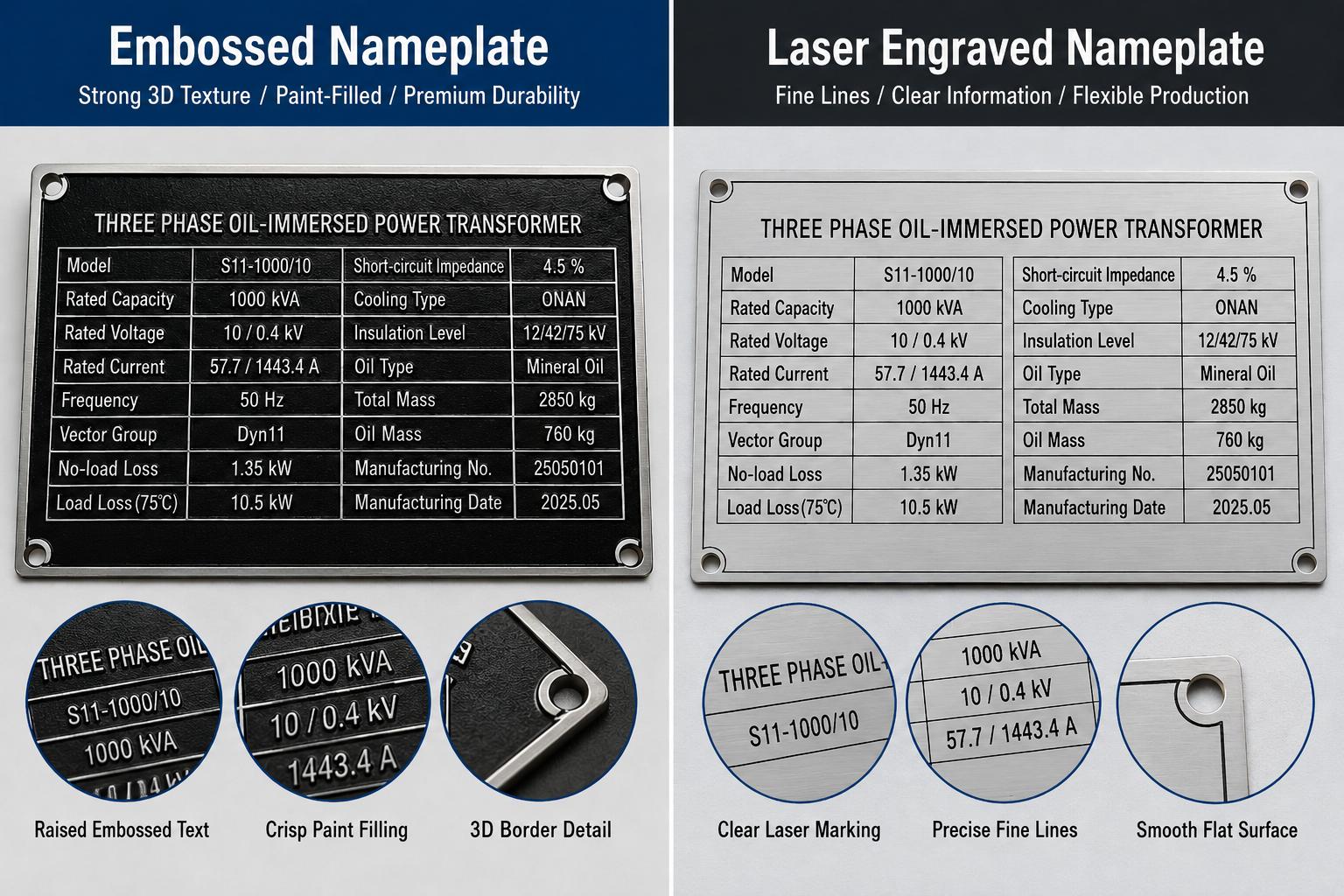
For these projects, the owner may require an embossed transformer nameplate instead of a flat laser engraved plate. The embossed process uses a custom mold and high-pressure stamping to create raised characters, numbers, and borders. Compared with flat surface marking, embossing provides stronger mechanical identification, a more three-dimensional appearance, and better resistance to tampering and fading.
This type of nameplate is particularly suitable for long-term outdoor utility transformers exposed to strong sunlight, humidity, rain, dust, and temperature variation. Its main limitation is that a dedicated mold is usually required, which makes it more suitable for stable batch projects rather than urgent small-batch orders with many model variations.
Colombia and Mexico often follow a dual compliance approach: IEC-based transformer design requirements combined with local electrical regulations or utility specifications. In Colombia, project requirements may involve RETIE-related electrical safety considerations. In Mexico, NOM-related requirements may also be relevant for certain electrical equipment applications and market access procedures.
For transformer nameplates, these markets commonly emphasize both material and process. The use of aluminum plates with a thickness of at least 1.0 mm, combined with deep etching and paint filling, improves corrosion resistance, mechanical strength, and long-term readability.
Etched and paint-filled nameplates provide high contrast between characters and background. The marking is clear, weather-resistant, and less likely to fade or peel under outdoor conditions. This solution is widely applicable to public distribution transformers, urban power distribution transformers, pad-mounted transformers, and PV transformer projects.
Costa Rica, the Dominican Republic, and Guatemala generally allow more flexible nameplate customization under the IEC-based compliance framework and local utility requirements. Depending on the project, standards or utility practices such as ICE, INDOTEC, or COGUANOR may be referenced in the technical specification.
For these markets, anodized aluminum plates, 304 stainless steel plates, and other corrosion-resistant materials are commonly used. Deep laser engraving, deep etching, paint filling, and, in some cases, embossed marking can be selected according to the project environment and acceptance requirements.
Because laser engraving and deep etching do not require mold development, they are efficient solutions for projects involving multiple transformer models, variable parameters, QR codes, logos, and small to medium batch production. These processes are especially suitable for pole-mounted transformers, renewable energy supporting transformers, including transformer for solar power plant and solar pv transformer applications, and distribution transformer projects with frequent specification changes.
Based on Huawan New Energy’s overseas tender experience, transformer nameplate compliance is a small detail that can have a significant impact on technical evaluation, factory inspection, customs documentation, site acceptance, and long-term operation. In Latin American and Central American power projects, nameplate requirements are often directly connected to local climate conditions, utility maintenance practices, and national electrical standards.
A non-compliant transformer nameplate may cause technical clarification, acceptance delay, rework, or even evaluation risk during tender submission. Therefore, manufacturers must not treat the rating plate as a generic accessory. Instead, the nameplate should be reviewed together with the transformer technical specification, drawings, language requirements, applicable standards, and project acceptance criteria.
Anhui Huawan New Energy Co., Ltd. understands both IEC-based transformer requirements and country-specific utility specifications. For each overseas project, we can provide one-to-one transformer nameplate customization, including material selection, marking process, layout design, parameter arrangement, multilingual content, QR code marking, and outdoor durability treatment.
From embossed transformer nameplates for high-standard utility projects to laser engraved transformer nameplates for flexible batch production, Huawan New Energy provides customized nameplate solutions for oil-immersed transformers, dry-type transformers, pole-mounted transformers, pad-mounted transformers, and renewable energy transformer applications. With project-oriented engineering support and strict manufacturing control, we help global customers reduce compliance risks and deliver transformer products that meet local market requirements.
Empowering the Grid, Serving Customers, Advancing Society

Empowering the Grid, Serving Customers, Advancing Society